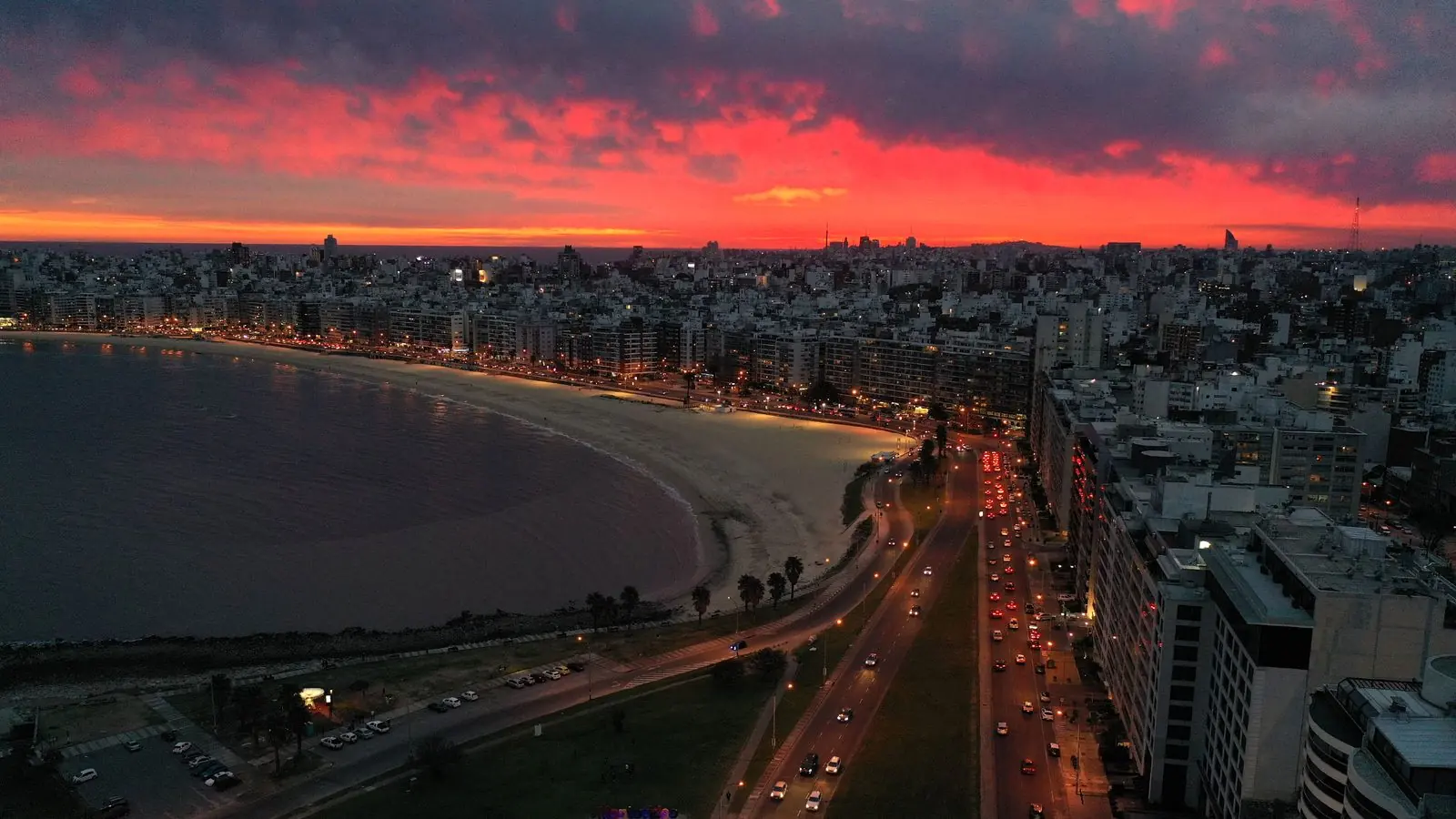
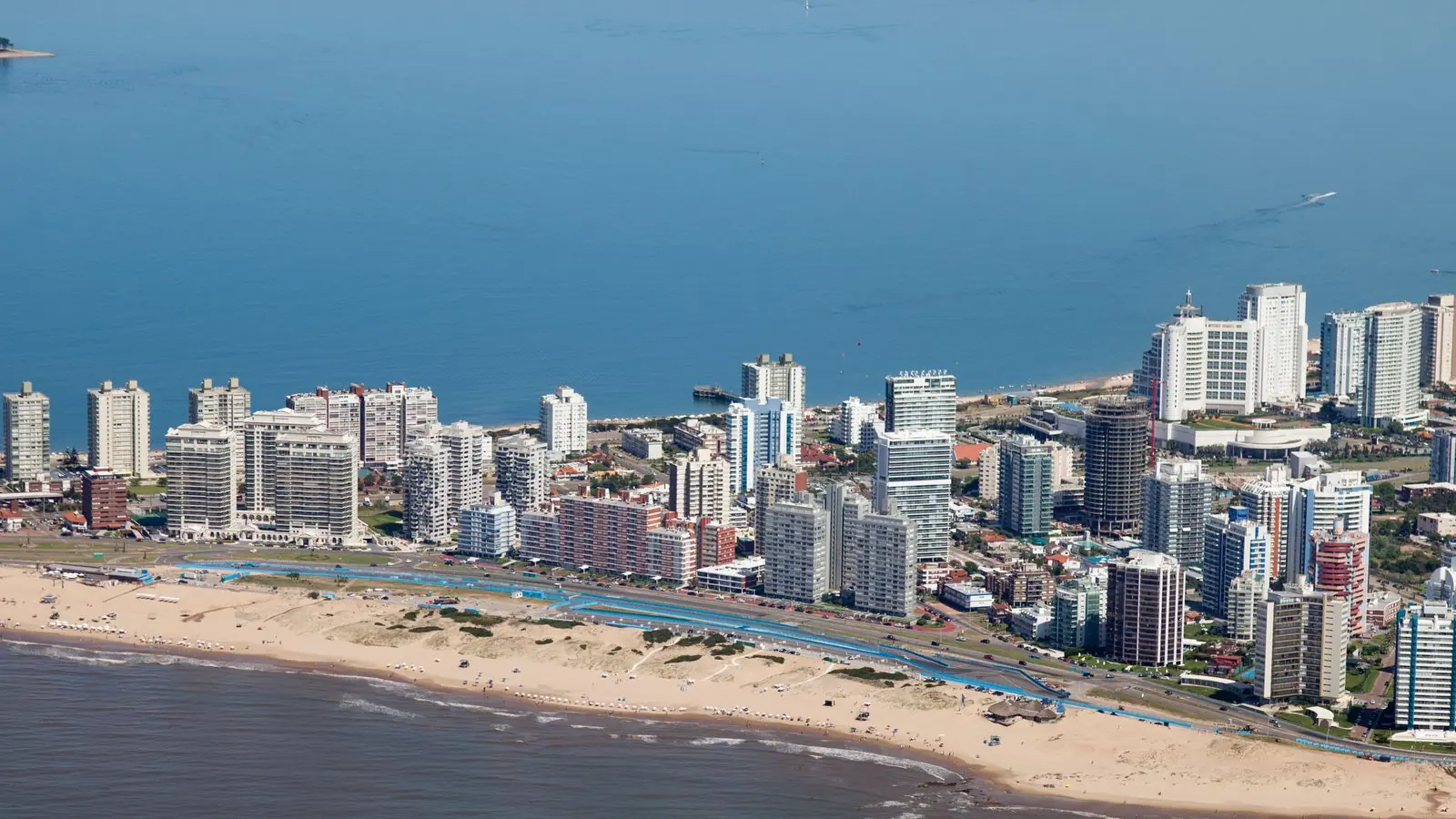
The first edition of the GREI Index maps asking prices in apartment listings across Montevideo, Punta del Este and Maldonado, zone by zone. It is a valuable tool, provided it is read correctly: these are listing prices, expressed as medians and split by type of product.
A new benchmark for an old question
Before viewing a property, almost every buyer asks the same question: what are sellers asking per square meter in this area? Since October 2026 there has been a public benchmark to help answer it. On October 13, the Uruguayan newspaper El Observador reported on the first edition of the GREI asking-price index, produced by the architecture firm Gustavo Ortega y Asociados (El Observador).
The index measures asking prices per square meter in sale listings published on property portals. Data for this first edition come from listings downloaded on September 28, 2026 for Maldonado and on September 29 for Montevideo (El Observador).
The headline figures
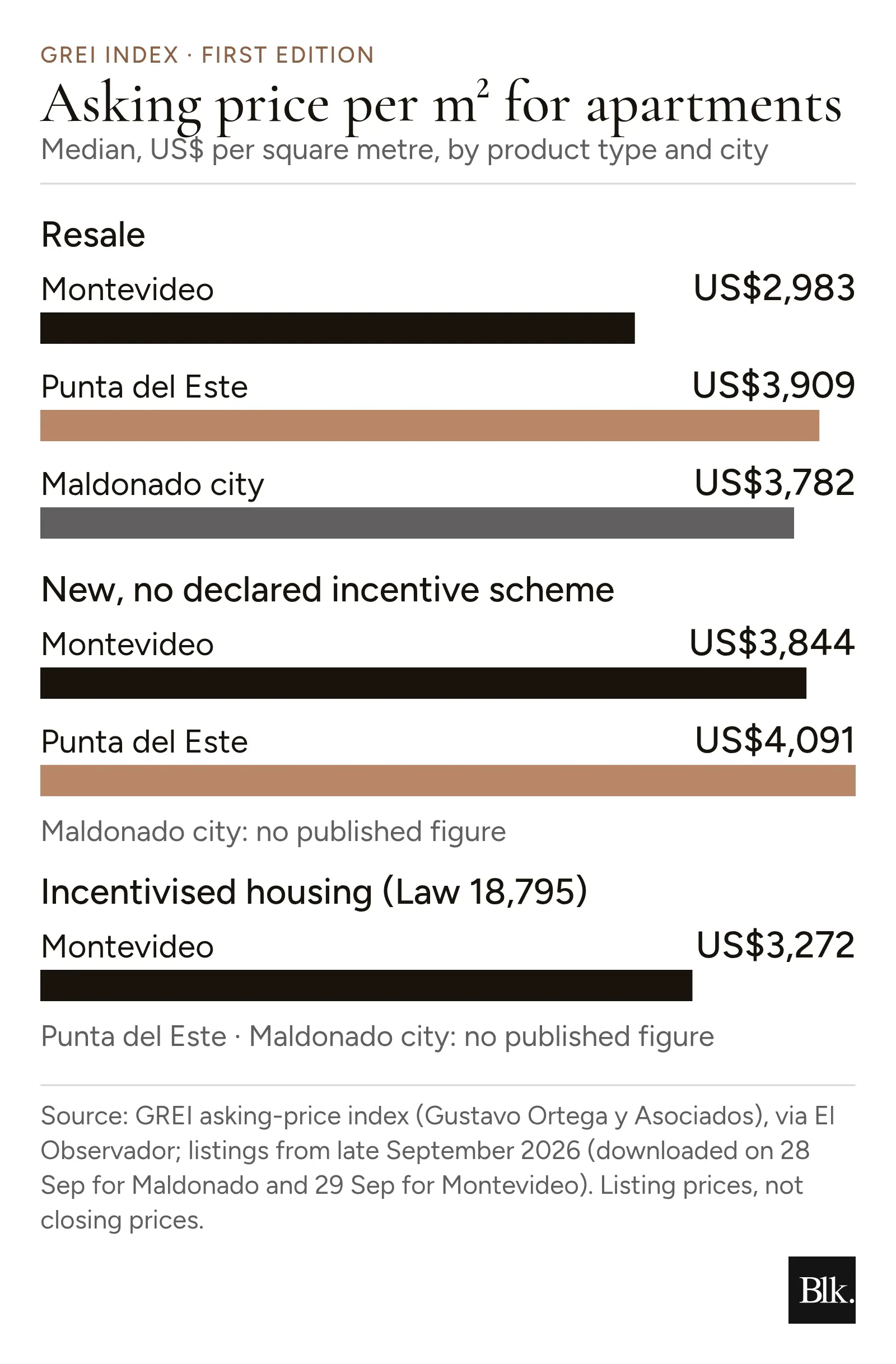
Median asking price per square meter for apartments, according to the GREI Index (El Observador):
Segment
Montevideo
Punta del Este
Maldonado city
Resale
US$2,983
US$3,909
US$3,782
New, no declared incentive scheme
US$3,844
US$4,091
—
Incentivized housing (Law 18,795)
US$3,272
—
—
According to the same report, the gap between Montevideo and Punta del Este is widest for resale units, where sellers in Punta del Este ask 31% more per square meter; for new units, the gap narrows to 6%. In Montevideo, incentivized housing is offered at a median 15% below that of new apartments without a declared incentive scheme.
After data cleaning, the samples are large: in Montevideo, 4,257 resale listings, 2,449 new and 1,735 incentivized; in Punta del Este, 1,689 resale and 740 new; in Maldonado city, 393 resale listings. Punta del Este figures refer to the cadastral locality and exclude Pinares and Maldonado city, which are measured separately.
Zone by zone
The interactive table accompanying the article shows how values vary within each city (GREI Index table published by El Observador). Some examples of median asking prices per m²:
Montevideo, new units without a declared incentive scheme: Carrasco US$4,706; Parque Rodó US$4,605; Bañados de Carrasco US$4,545; Punta Carretas US$4,403; Pocitos US$4,036.
Punta del Este: La Pastora Costanera, new US$4,324 and resale US$4,159; La Pastora Resto, new US$4,068 and resale US$3,889; Punta del Este Balneario, resale US$3,631; Gorlero, resale US$3,250.
Two points stand out. First, in Montevideo's coastal neighborhoods, asking prices sit well above the city median and come close to, or even exceed, those of Punta del Este. Second, within Punta del Este the difference between zones matters as much as the difference between cities. "The price per square meter in Punta del Este" means little unless you specify where.
How to read these numbers
Asking price is not selling price
The report itself is clear: the index does not measure the prices at which sales are actually closed, nor can it establish the value of any individual property. Between the listed price and the final deed there is usually a negotiation, whose extent depends on the property, its time on the market and timing; the index does not measure it, and generic percentages are best treated with caution.
The median is not the average
The median is the middle value when all listings are ranked: half ask more, half ask less. Unlike the average, it is not pulled up or down by a handful of exceptionally expensive or inexpensive properties. That makes it a good measure of what is "typical", but it does not describe the top of the market: a premium property may sit well above the median of its own zone.
Resale, new and incentivized: three different markets
The index classifies apartments as resale, new without a declared incentive scheme, or incentivized housing, when the listing or project identifies them as such. Comparing a resale unit with a new one means comparing products of different age, finishes and services. Incentivized housing, under Law 18,795, also operates within its own framework.
Floor areas and zones
The calculation uses the floor area stated in each listing and, where two are given, takes the smaller one. As the report notes, areas are not always comparable: they may include terraces or common areas. Listings are placed by their coordinates within official zones, not by the neighborhood the advertiser names, and listings without a price, duplicates and "from" project prices, among others, are excluded. Each figure carries a margin of error based on a 95% confidence interval, and results are published only for zones that meet minimum requirements, such as at least three agencies with none holding half of the listings (El Observador).
What sets a premium property apart from the median
A median summarizes a market; a high-end property, by contrast, is defined by its particulars. When interpreting why a home departs from the typical value of its zone, certain factors are, in our experience, decisive:
Precise location: within the same neighborhood, the block, surroundings and access make a difference.
Views and seafront position: frontline locations and open views are scarce and hard to replicate.
Build quality: design, materials, insulation and finishes.
Amenities and services: security, shared spaces, parking and building services.
Condition: an updated resale home is not the same as one that needs work.
Orientation and natural light: factors that shape everyday comfort.
None of these attributes shows up in an average, and that is precisely the point: the index provides the context; valuing each property requires case-by-case analysis.
What comes next
As this is the first edition, the index cannot yet show whether prices are rising or falling. Future editions will allow comparisons over time, bearing in mind the margin of error and that changes may also reflect shifts in the type of homes on offer (El Observador). We will follow those updates closely.
Let's talk
If you are considering buying or selling in Montevideo or on Uruguay's east coast, we would be glad to help you put these figures in context for your specific situation. Let's talk: write to us at welcome@blk.uy or visit us at Av. J. M. Ferrari 1413, Montevideo.