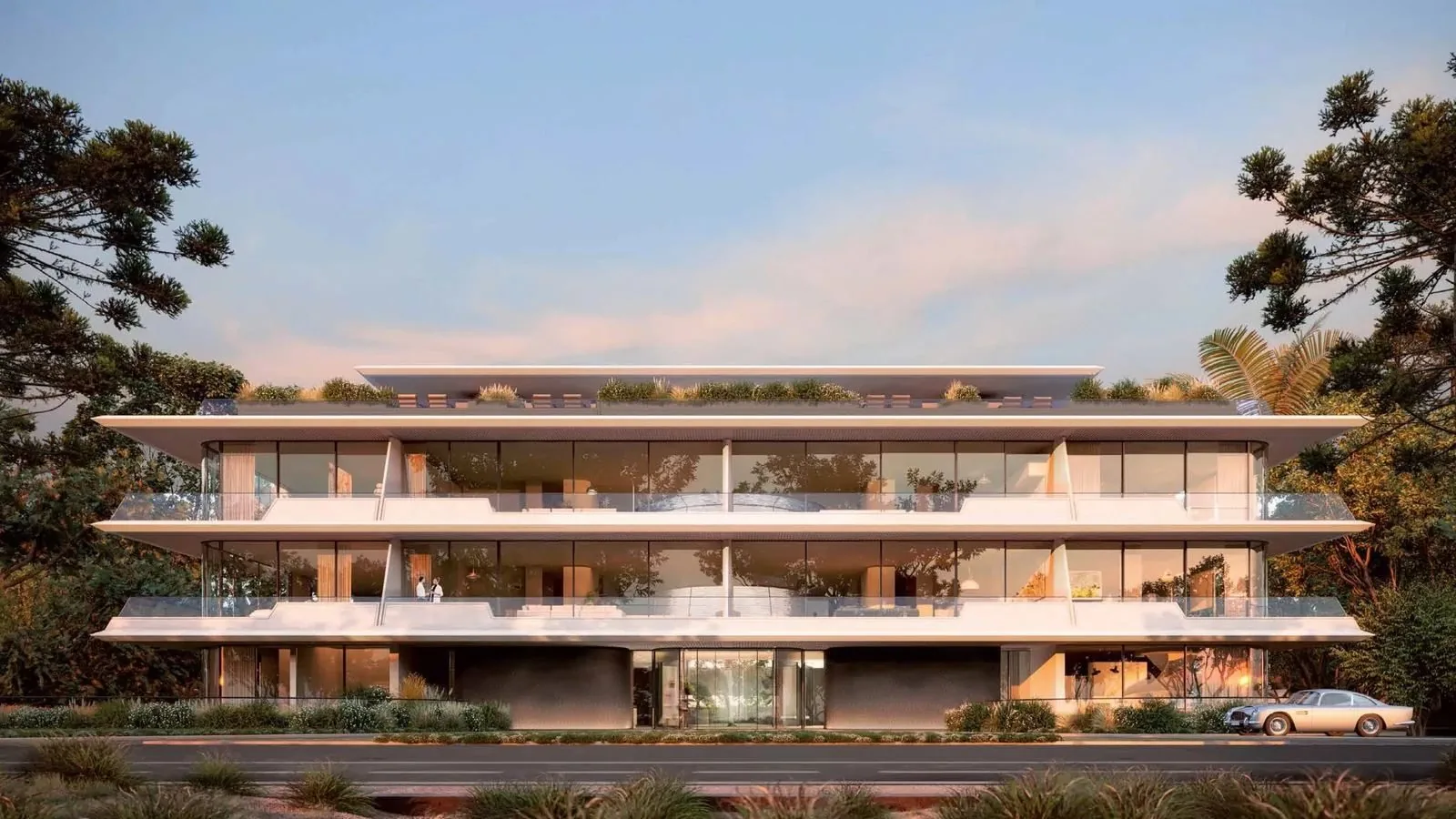
Image: The Edge rendering
Private investment in housing tops US$3,500 million a year, according to Appcu president Alfredo Kaplan. But developers are raising concerns about rising costs and slow project approvals. Here is what that means if you are thinking about buying off-plan.
A "mega investment" that often goes unnoticed
When people talk about large investments in Uruguay, the conversation usually turns to pulp mills. Yet private residential construction moves money on that scale every year. In an interview published by El País on October 19, 2026, Construction Day, Alfredo Kaplan, president of the Association of Private Construction Developers of Uruguay (Appcu), estimated that housing developers invest more than US$3,500 million a year.
According to Kaplan, construction employs 57,000 workers, nearly 40,000 of them in housing. He describes the year as one of steady investment. Compared with 2025, he said investment would be no lower, and some figures put it about 10% higher, although he noted he has no objective data to confirm that.
What developers are asking for: costs and delays
The interview goes beyond the headline number. Kaplan raised two main concerns.
Costs. The five-year agreement signed with the Sunca construction union, he said, raised costs, though it also provides a framework of relative labor peace for medium-term planning. Projects already underway had contracts with adjustment clauses, he explained, while new projects must factor in the new costs. In a traditional project, labor accounts for no less than 40% of construction costs, excluding land. There is also a currency mismatch: homes are sold in US dollars, but most costs are paid in Uruguayan pesos.
Delays. For Kaplan, time is a cost in itself in a process that runs from buying the land to finishing the building. The problem, he said, is "unnecessary time" spent at municipal governments, at the National Housing Agency (ANV), and in the review of large-scale economic projects. Appcu has proposed to the Ministry of Economy a "positive silence" rule: if a project receives no objections within four months, it would be tacitly approved, under the responsibility of the professional in charge. Kaplan also asked to extend, through December 31, 2030, the filing deadline for the smallest category of large-scale economic projects, between US$5 million and US$10 million.
What it means if you buy off-plan
If you are considering an off-plan purchase, these concerns offer useful context. An off-plan project depends on permits, timelines, and costs that can change between signing and delivery. So beyond price and location, it pays to look at a few points:
- What stage the project is in. Kaplan distinguishes between projects just starting, projects under construction, and projects nearing completion. A project with approved permits and work underway has already moved past part of the permitting uncertainty.
- How the price adjusts. Because sales are in dollars and costs are in pesos, read the contract's adjustment clauses carefully.
- Who is behind it. The development, design, and construction team shapes how the unexpected gets handled.
Kaplan also shared a demand figure: 20 years ago, the average Uruguayan household had 3.9 people; today it has 2.3. With the same population, he explained, that creates the need for many more households. In the promoted-housing segment, one- and two-bedroom units are moving the most, he said, while the premium segment works as a different market.
Important: this article makes no promise of returns and offers no guarantees. Every project depends on its execution, timelines, and entry point. Before deciding, review the transaction with an advisor.
Strong teams: the case of The Edge
When timelines and costs can shift, the strength of the team is one of the criteria worth weighing. One project Blk. Realty follows closely is The Edge, on the Rambla de Carrasco in Montevideo. It is designed by Foster + Partners together with Ponce de León Architects, developed by Betalba Capital, with architect Álvaro Pallas as Project Manager. It comprises eight residences with two to four bedrooms.
According to the latest construction update published in the Magazine (October 2026), the exposed white concrete structure will be complete before year-end, and the building will be finished by late 2027. That is not a guarantee of results, but it is concrete progress information you can review before deciding.
A market still in motion
For next year, Kaplan hopes to at least maintain the pace of investment. He also noted that Uruguayans are the main buyers of property in the country, and that legal certainty is something investors from neighboring countries value too. Maldonado and Canelones, he said, are the departments where the most square meters are being built.
If you want to review an off-plan project with clear data, Blk. Realty is here to help.
Blk. Realty · Uruguay
Sources
- El País (Lautaro Brum), "La construcción en vivienda mueve US$ 3.500 millones en Uruguay: los reclamos de promotores por costos y demoras," October 19, 2026: https://www.elpais.com.uy/negocios/noticias/la-construccion-en-vivienda-mueve-us-3-500-millones-en-uruguay-los-reclamos-de-promotores-por-costos-y-demoras
- Blk. Realty Magazine, "The Edge: white concrete," October 14, 2026.
- Blk. Realty Magazine, "The Edge," January 5, 2024.